
From Long Weekend to Lifted Look: Planning a Low-Profile Facelift

The Facelift That Works with Your Calendar
You lead a fast-paced life, constantly balancing high-stakes meetings, decision-making, and the quiet pressure to always be “on.” You take care of your team, your family, your deadlines—but when was the last time you paused to take care of you? If you've started noticing subtle signs of aging in the mirror—maybe a bit of laxity around your jawline or a tired look you don’t quite recognize you should know that many women in demanding leadership roles feel the same. The good news? There’s a way to refresh your look with a low-profile facelift without stepping away from your life or taking a lengthy leave from work.
Why More Executive Women Are Choosing “Quiet” Facelifts
You’ve likely mastered the art of doing things strategically—and your approach to how you age is no different. Many of the professional women I work with aren't looking for dramatic changes. They're simply ready to address the early signs of aging in a way that feels intentional and understated.
Today’s facelift techniques aren’t about turning back time twenty years—they’re about helping you look more rested, more energized, and more like yourself. That’s why “quiet” facelifts are becoming so popular among women in high-powered roles. These are procedures designed to refresh your appearance without announcing it to the world.
You don’t need to explain anything to colleagues or clients. In fact, most people just assume you had a relaxing weekend or finally caught up on sleep. That’s the beauty of a well-done, low-profile facelift: it works subtly behind the scenes, just like you do.
The women I see in my practice value privacy, efficiency, and results that blend seamlessly into their lives—and their leadership roles. If that sounds like you, you’re already on the right path.
The Long-Weekend Facelift Strategy
If you’re already thinking, When would I even have time for this?, don’t worry—you’re not alone. One of the most common questions I hear is, “How can I fit this into my schedule without missing a beat?”
That’s where the long-weekend facelift strategy comes in.
By scheduling your procedure on a Thursday or Friday, you can use the weekend to rest and recover in peace—no need to alert your team or clear your calendar for weeks. Thanks to modern surgical techniques, we’re able to minimize bruising, swelling, and downtime while still delivering beautiful, lasting results.
So, what makes a facelift “low-profile”? It’s not just about smaller incisions or a shorter recovery—it’s about personalization. I take time to understand your facial structure, your concerns, and your timeline. From there, I tailor a surgical plan that enhances your features subtly and strategically. Sometimes this means a mini facelift, sometimes a neck refinement, or sometimes a combination of less invasive enhancements that work together in harmony.
The goal is always the same: maximum impact, minimal disruption. You walk away looking refreshed—not operated on—and with your calendar still intact.
What to Expect—Day by Day
Knowing what to expect makes all the difference—especially when your schedule doesn’t have much room for surprises. Here’s how the facelift experience typically unfolds when planned over a long weekend. Of course, every person heals a little differently, but this timeline gives you a realistic idea of what recovery might look like.
Day 0 (Surgery Day)
Your procedure will take place in a fully accredited surgical setting where you’ll be cared for with the highest standards of safety and discretion. Once you’re comfortable under anesthesia, I’ll perform your customized facelift—whether it’s a mini lift, neck refinement, or a combination approach.
You’ll head home the same day with a soft dressing around your face and detailed post-op instructions. Most of my patients spend the rest of the day resting, keeping their head elevated, and simply relaxing.
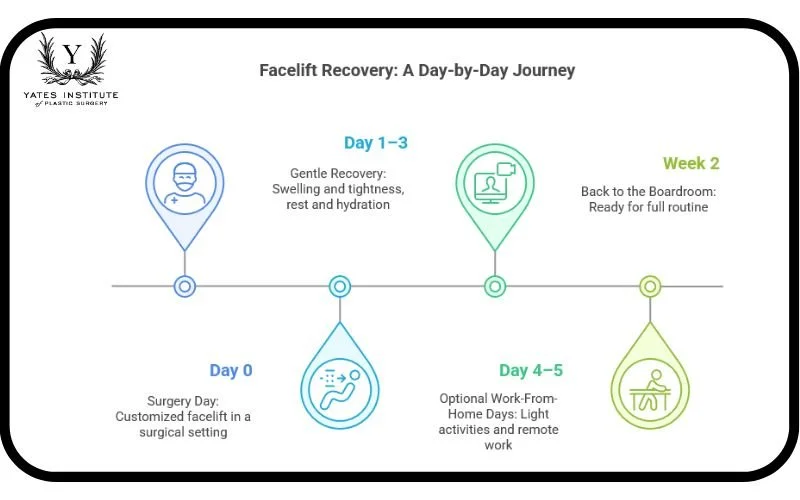
Day 1–3 (The Weekend)
These first few days are all about gentle recovery. Swelling and tightness are normal, but most patients are pleasantly surprised at how manageable the discomfort is. You might feel a little groggy the day after surgery, but by day two or three, you’ll already notice the swelling beginning to settle.
I encourage you to rest, stay hydrated, and give yourself permission to unplug. If you’ve ever dreamed of an excuse to cancel your weekend plans guilt-free—this is it.
Day 4–5 (Optional Work-From-Home Days)
By Monday or Tuesday, many patients feel well enough to ease back into light activities or remote work. You may still have mild bruising or puffiness, but with a little planning (and maybe a strategic Zoom filter), you’ll feel presentable and focused.
Some patients return to in-person meetings around this time if they’re comfortable, while others prefer to keep things light for a few more days. That’s completely up to you and how your recovery is going.
Week 2 and Beyond: Back to the Boardroom
By the second week, most of the visible swelling has faded. You’ll be ready to step back into your full routine—looking refreshed, polished, and well-rested. People might comment that you look great but won’t be able to put their finger on why.
And that’s exactly the point.
Your results will continue to improve as healing progresses, revealing a natural lift that complements your features—not alters them.
Timing Your Facelift Around Your Career Calendar

When your schedule is stacked with meetings, travel, and decision-making, finding the right time for anything personal can feel impossible. But planning a low-profile facelift doesn’t mean clearing your calendar for weeks—it just means being strategic.
Many of my patients schedule their procedures just before a long holiday weekend or use a few PTO days to create a quiet recovery window. If you already have remote work days or lighter weeks on your calendar, we can coordinate your surgery around that. Some even use the time after a big event—like a keynote presentation or board meeting—as a perfect opportunity to step away briefly and return recharged.
I also recommend building in a small “buffer” if you have upcoming public appearances, photo sessions, or conferences. Even though most people are presentable within 7–10 days, giving yourself a little extra breathing room can help you feel fully ready—physically and mentally.
Remember, this is your procedure, your timeline, and your life. I’m here to help make it work for you, not the other way around.
Discretion Is the New Luxury
You’ve likely spent years curating your professional presence. So when it comes to facial rejuvenation, subtlety is everything. The goal isn’t to look like someone else—it’s to look like you on your best day, every day.
That’s why I approach every facelift with precision and discretion. We’ll start with a thorough consultation to discuss your goals, lifestyle, and comfort level. From there, I’ll create a custom plan that targets the areas that matter most to you—whether that’s a touch of jawline definition, softening of marionette lines, or smoothing out the neck.
Many women also choose to combine a mini facelift with complementary procedures like an upper eyelid lift or lip enhancement. These combinations can create balanced, natural results—without extending your downtime.
Because we’re focusing on refinement rather than transformation, you’ll never walk out of my office looking “overdone.” Instead, you’ll look rested, lifted, and completely in control—just like always.
Realistic Results, Real-Life Confidence
I hear this often from my patients: “I don’t want to look different—I just want to look like I actually feel.”
That’s exactly what a well-executed facelift can offer. The results aren’t drastic or obvious. They’re tailored to your features and designed to quietly refresh and restore. Most patients tell me they look brighter, more awake, and more at ease—but no one can tell why.
When your outer appearance reflects your inner energy, you naturally show up more confidently in every aspect of your life.
Over the years, I’ve had the privilege of working with many high-achieving women who were initially hesitant about surgery. But once they saw how seamless the process could be—and how natural the results looked—they often told me they wished they’d done it sooner.
You deserve to look as powerful, composed, and polished as you feel. And with today’s refined techniques, you can—on your terms.
Is a Low-Profile Facelift Right for You?
You don’t need to wait until the signs of aging become dramatic to take action. In fact, many of the women I treat are in their 40s and 50s—just starting to notice skin laxity along the jawline, a bit of heaviness in the lower face, or that their injectables aren’t quite cutting it anymore.
If you’re in good health, have realistic expectations, and want subtle, long-lasting results without a drawn-out recovery, you might be an excellent candidate for a low-profile facelift.
You may also be feeling what I call “filler fatigue.” That’s when temporary fixes like dermal fillers or skin tightening treatments no longer deliver the same results—and may even start making your face feel overfilled or puffy. At that point, a surgical solution often feels like a breath of fresh air: refined, permanent, and more in tune with your natural structure.
During your consultation, I’ll take the time to understand your goals, answer your questions, and evaluate whether this approach is the right fit for you. There’s no pressure—just a thoughtful, honest conversation about what’s possible and what works for your lifestyle.
Final Words
A low-profile facelift is about refinement, presence, and feeling in alignment with the person you are today. It’s about investing in you—in a way that works with your life.
If you’re ready to explore your options, I’d love to help you take that next step. Let’s create a plan that’s tailored, discreet, and designed to help you look as powerful and polished as you already are.
FAQs about Facelift Surgery
How long will the results of a low-profile facelift last?
Results typically last 7 to 10 years, depending on your skin quality, lifestyle, and how your face continues to age. The goal is long-term enhancement, not a temporary fix.
Will I need to stop working out after surgery?
Yes, but only briefly. I usually recommend avoiding strenuous activity, including cardio and weight training, for about 2–3 weeks. We’ll give you personalized clearance when it’s safe to resume.
Can I combine a low-profile facelift with non-surgical treatments like Botox or laser?
Absolutely. Many of my patients continue their regular maintenance treatments after surgery to enhance and extend their results. These can be integrated thoughtfully into your long-term plan.
Will I need to have drains after surgery?
Not always. For mini facelifts and less invasive techniques, I often avoid using drains altogether. If they’re necessary in your case, I’ll explain why and ensure you know exactly how to manage them.
What if I’m not ready for surgery but still want to look fresher?
That’s completely valid—and something we can absolutely discuss. I offer a range of non-surgical options like skin boosters, injectables, and skin tightening treatments. If surgery isn’t the right step just yet, we’ll find an alternative that fits your goals.
Further Reading about Facelift Surgery at the Yates Institute of Plastic Surgery
Read more about The Facelift Timeline: From Consultation to Recovery
Read more about Types of Facelift Procedures in Fort Lauderdale
Read more about Pre and Post-Op Tips for Better Results after Facelift Surgery
Read more about Is a Facelift Right for Me?
Read more about Facelift Recovery Tips for Fort Lauderdale Residents