Tubular Breasts: Causes and Treatment
What if the breast shape you’ve wondered about for years actually has a name, a cause, and a solution?
Many of my patients come to me after feeling uncertain about their breast development since adolescence. They’ve noticed a narrow shape, fuller areolas, or a difference between the two sides, but never understood why. That confusion is incredibly common, and it often leads people to believe they’re alone.
The truth is, tubular breasts are far more frequent than most women realize. This natural variation in breast development can influence shape, fullness, and symmetry in ways that feel unfamiliar or unexpected.
If you’ve spent years trying to make sense of your breast shape or searching for options to create a rounder, more balanced look, you’re in the right place.
My goal is to help you understand what tubular breasts are, how they’re diagnosed, and the techniques I use to create soft, natural contours that align with your goals.
If you’re ready to explore your options more personally, you’re welcome to schedule a consultation at the Yates Institute of Plastic Surgery in Fort Lauderdale.
What Are Tubular Breasts?
Tubular breasts are a developmental breast shape that forms during puberty. Instead of growing into a round, evenly distributed form, the breast tissue is restricted by tight connective bands.
Because of this, the breast develops in a narrow, cylindrical shape, often with less volume in the lower half.
Most patients notice features such as:
A narrow base or cone-like shape
Fullness concentrated behind the areola
Puffy or enlarged areolas
A high breast fold
A gap between the breasts
One breast significantly smaller than the other
One of the biggest misconceptions is that this condition stems from something a person did or didn’t do.
In reality, tubular breasts are simply part of your natural anatomy. They vary widely in severity, from subtle shape differences to more noticeable asymmetry or constriction.
Understanding this is the first step in realizing that you’re not alone, and you’re certainly not at fault. Many women live with tubular breasts without ever hearing the name for it, often thinking they’re the only ones who developed this way.
Diagnosing Tubular Breasts

Diagnosis begins with a thoughtful, detailed evaluation. When you visit me at the Yates Institute, we look at the underlying structure rather than just the visible shape. Tubular breasts have several specific characteristics, and these features guide the surgical plan.
During your consultation, I assess:
Breast base width. Tubular breasts often start with a tight, narrow base.
Lower-pole development. When the lower part of the breast hasn’t expanded properly, the shape can feel “tight” or elongated.
Areolar changes. Herniation of breast tissue behind the areola gives it a puffy or enlarged appearance.
Degree of asymmetry. Many patients have noticeable differences between their two breasts.
Skin elasticity and soft-tissue support. This determines how much reshaping can be done in a single stage.
Every diagnosis is personal.
No two tubular breasts are identical, which is why a customized approach is essential. You and I talk through your goals, what you’d like your breasts to look like, and how various treatment options can help you achieve those changes.
Treatment Options
Correcting tubular breasts is one of the most rewarding procedures in aesthetic breast surgery, because it allows me to reshape the breast from the inside out, not just add volume.
The goal is to release the constricted tissue, create a rounder and more proportionate shape, and refine the areola if needed.
The treatment plan can include one or several techniques:
1. Releasing the Constricted Tissue
The first step is often addressing the tight lower pole. By releasing the internal bands that restrict breast development, the breast can expand into a more natural contour. This foundational step is crucial for long-term, stable results.
2. Areola Reshaping
If the areola appears enlarged or puffy, I can reposition and reshape it. This excess projection is caused by breast tissue pushing forward behind the areola, so reducing that herniation brings harmony to the breast shape.
3. Implants for Shape and Volume
Implants are commonly used in tubular breast correction, not simply to add size but to improve structure. An implant helps widen the base of the breast, add fullness to the lower pole, and enhance symmetry. I guide you through various implant types, profiles, and placements to find the best match for your anatomy and goals.
4. Fat Grafting
For some patients, adding their own natural fat helps soften transitions, improve shape, and add subtle volume. Fat grafting can be used alone or combined with implants for even better contouring.
5. Single-Stage or Staged Procedures
Milder cases can often be corrected in just one surgery. More severe forms may benefit from a two-stage approach, allowing the tissues to stretch and settle between steps. During your consultation, we’ll decide what’s safest and most effective for your anatomy.
To give you a clearer picture of how these techniques work together during tubular breast correction, here’s a simple overview of the most common methods I use and what each one is designed to accomplish.
Table: Tubular Breast Correction Techniques
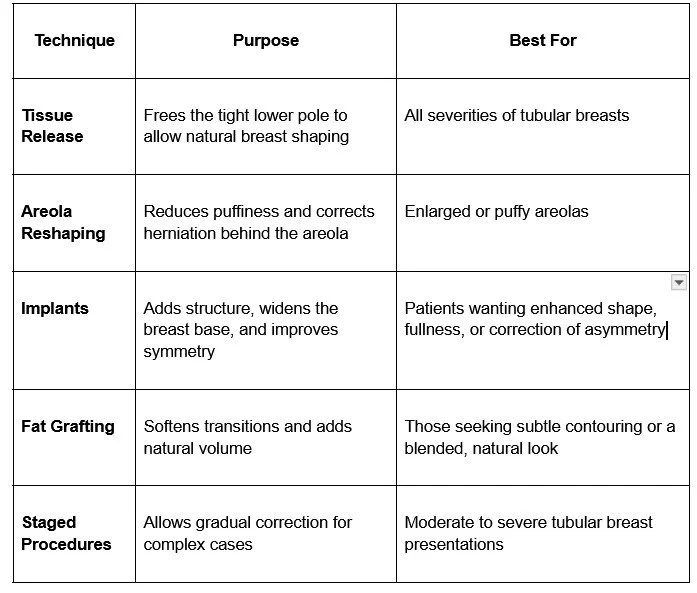
This overview helps you see how each technique plays a different role in shaping the final result and how they can be combined to create a balanced, natural outcome tailored to your anatomy.
Who Is a Good Candidate for Tubular Breast Correction?
Most women with tubular breasts are excellent candidates for surgical correction. You may benefit from treatment if you:
Feel your breasts appear long, narrow, or underdeveloped
Notice puffiness or fullness behind the areolas
Experience significant asymmetry
Have difficulty finding bras that fit comfortably
Want a rounder or more proportionate breast shape
Ideal candidates are in good overall health and have realistic goals. You don’t need to desire large breasts.
Many patients simply want their breasts to look balanced, softer, and more natural in clothing and swimwear.
During your consultation, I take the time to understand exactly what you’re hoping to change, and together we create a plan that fits your goals and lifestyle.
Final Thoughts
If you’ve lived with tubular breasts and felt unsure about your body or confused about why your breasts developed the way they did, you’re far from alone.
Many women spend years searching for answers before realizing that what they’re experiencing is a known and very treatable condition.
My goal as a plastic surgeon is to help you understand your anatomy, explore your options, and feel supported at every step of your journey. Tubular breast correction can create meaningful changes in symmetry, fullness, and overall body balance. More importantly, it can help you feel more at ease with your own shape.
If you’re ready to explore what’s possible, I welcome you to take the next step and meet with me at the Yates Institute of Plastic Surgery in Fort Lauderdale. Schedule your consultation now and start your journey toward a shape that feels natural, balanced, and truly your own.
FAQs about Tubular Breasts
Can tubular breasts be corrected without implants?
Yes, in some cases. Fat grafting or tissue release alone may be enough for milder tubular shapes, especially when the main concern is lower-pole constriction or areolar herniation. That said, implants are often the most effective way to correct both the narrow base and the lack of fullness in the lower half of the breast. During your consultation, we’ll explore what each approach can realistically achieve for your anatomy so you can choose the option that feels right for you.
Can I breastfeed after tubular breast surgery?
Many patients are still able to breastfeed after tubular breast correction. The ability to breastfeed depends on several factors, including how your breasts developed initially and which surgical techniques are used. If future breastfeeding is important to you, we’ll review your goals during the consultation and choose a surgical plan that preserves as much natural function as possible.
Is this a painful recovery?
Most patients describe the recovery as uncomfortable rather than painful. Medication helps manage soreness in the first few days, and many women return to desk work or light activities quickly. You’ll receive clear instructions about movement, support garments, and when it’s safe to resume exercise. My team and I stay in close contact with you throughout recovery to make sure you feel supported.
Will the results look natural?
Yes. Modern techniques allow us to reshape the breast in a way that restores balance, roundness, and softness while still fitting your body proportions. The goal is to correct the constricted features of tubular breasts without creating an overly augmented look. We’ll review photos, discuss your preferences, and design a plan that focuses on a natural outcome.
Is tubular breast correction a one-stage or two-stage procedure?
That depends on the severity of the constriction. Milder cases often achieve excellent results in a single surgery. More pronounced tubular features may require a staged approach to gradually expand the tissue and achieve the best possible shape. We’ll determine the safest and most predictable plan for your anatomy during your consultation.
Will the scars be noticeable?
Scars typically heal very well with proper care. Their placement depends on the techniques used, but I aim to keep them discreet and minimal. I’ll review scar-care instructions with you and follow your healing closely.
Read more blogs:
References: